
📌 In clinical practice, many patients come to us because of pain. Most improve to some extent with appropriate treatment. However, there is a group of patients whose pain remains difficult to control despite our efforts.
When we look more closely, some of these patients report heavy cigarette smoking and frequent or high-dose cannabis use. This does not mean that smoking or cannabis is necessarily the reason their treatment does not work. Chronic pain is complex and is influenced by many factors. However, these habits may be part of the bigger picture and are worth considering when pain does not improve as expected.
Cannabis and the pain system
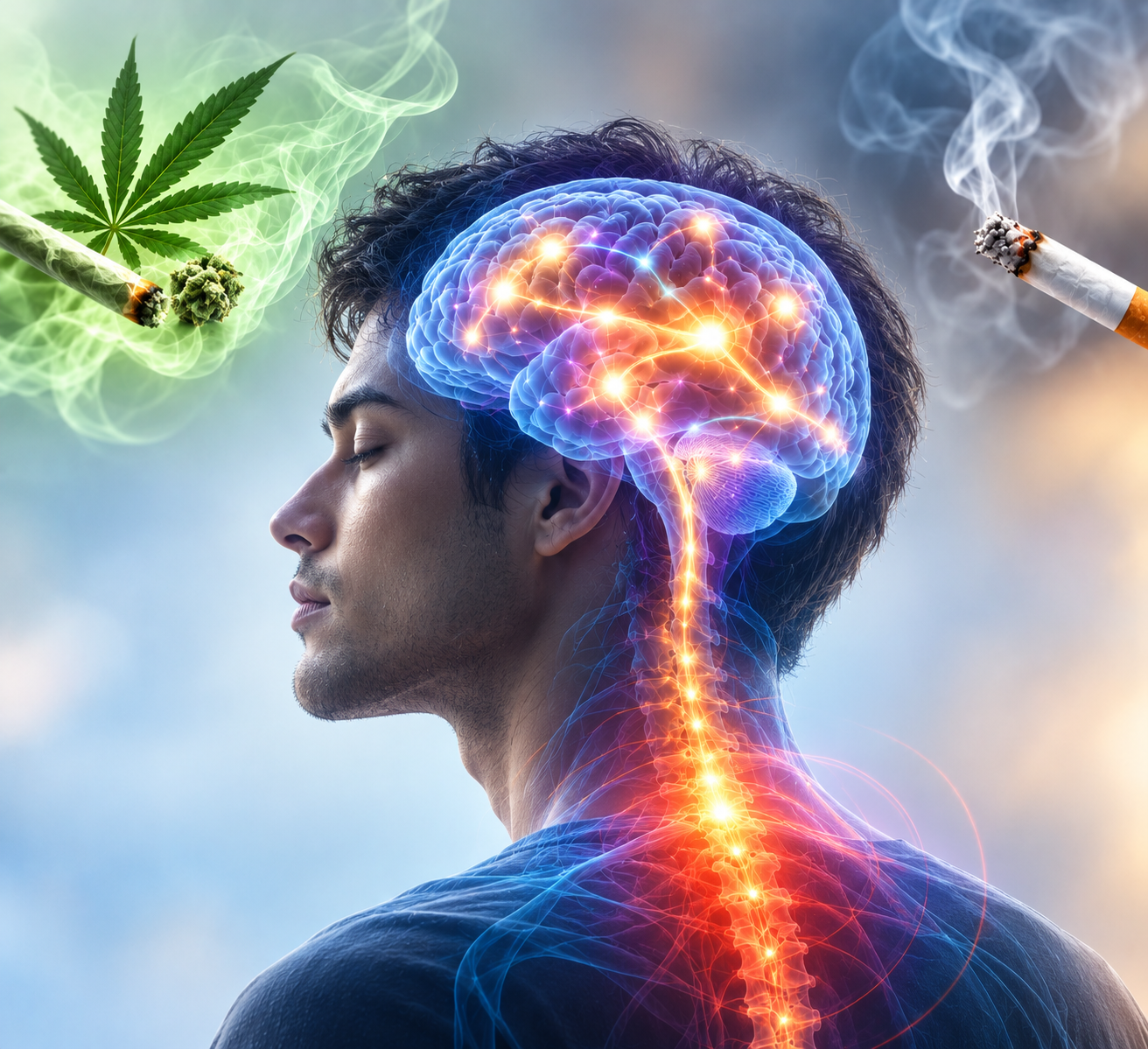
Cannabis, particularly THC, acts mainly through cannabinoid CB1 receptors in the brain and nervous system. These receptors are involved in the modulation of pain, emotion, reward, and other neurological functions.
In the short term, cannabis may change how pain is perceived and, in some people, may provide analgesic effects. However, with frequent or long-term use, the nervous system can adapt to continued cannabinoid exposure.
Human PET imaging studies have shown that chronic daily cannabis use is associated with reduced availability of CB1 receptors in several brain regions involved in pain processing. Importantly, this change appears to be at least partly reversible after abstinence, suggesting that the brain adapts to repeated exposure rather than simply remaining in the same state.
🎯 This raises an important clinical question: could long-term, heavy cannabis use alter the way the nervous system responds to pain?
Some clinical evidence points in this direction. A 2023 study found that daily cannabis users had lower pain tolerance during a cold-pressor test than non-daily users. Those using both cannabis and tobacco had the shortest pain tolerance in the study. However, this was an observational study, so it cannot establish that cannabis or tobacco directly caused the difference.
What about heavy cigarette smoking?
Nicotine is also capable of affecting pain pathways. Acute nicotine exposure can produce short-term analgesic effects, but the picture becomes more complicated with chronic smoking.
Studies have found an association between cigarette smoking and chronic musculoskeletal pain. Experimental research also suggests that long-term nicotine exposure may alter neural circuits involved in pain processing, including pathways connecting the ventral tegmental area (VTA) with the anterior cingulate cortex (ACC), an important brain region in the experience and emotional processing of pain.
In other words, the effect of nicotine on pain may change over time. What initially feels like pain relief does not necessarily mean that long-term smoking is beneficial for someone living with chronic pain.
When cannabis and tobacco are used together
For patients who use both cannabis and cigarettes heavily, the situation may be even more complicated. Both substances interact with brain systems involved in reward, stress, and pain modulation, and repeated exposure can lead to neuroadaptation.
Current evidence suggests an association between cannabis/tobacco use and pain, but we still cannot conclude that using them together directly causes treatment failure. In fact, the relationship may work in both directions: people with persistent pain may be more likely to use cannabis or tobacco, while long-term use may also influence how pain is processed.
This distinction is important in clinical practice.
So, what should we do differently?
When a patient has persistent pain despite appropriate treatment, it may be helpful to look beyond the original source of pain.
We should ask about smoking and cannabis use—not simply whether the patient uses them, but how much, how often, for how long, and what happens to their pain after use. Sleep, stress, mood, physical activity, and other factors should also be considered.
For some patients, treating the original cause of pain may not be enough. We may also need to address central sensitization, where the nervous system becomes increasingly sensitive to pain signals.
🌿 This is where a multimodal approach can be useful. Depending on the individual patient, treatment may include medication, physical rehabilitation, sleep and lifestyle interventions, behavioral strategies, education, and practical techniques that help reduce factors maintaining pain.
The goal is not simply to tell patients to stop smoking or stop using cannabis. Rather, it is to understand how these behaviors may interact with their pain and treatment, and to develop a realistic plan together.