

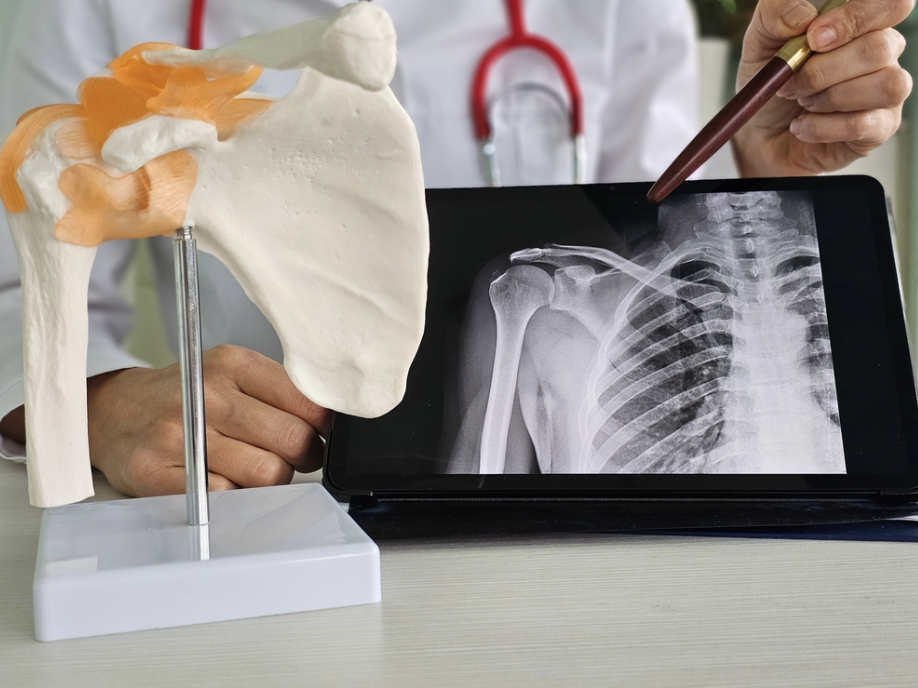
A recent review by Haas, Ibounig, and Buchbinder in JAMA Internal Medicine, Management of Shoulder Pain in Primary Care, offers an interesting perspective on how we should assess patients with shoulder pain.
The key message is simple:
When assessing shoulder pain, we do not always need to identify exactly which structure is causing the pain.
📌 Conditions such as rotator cuff tendinopathy, bursitis, impingement, and partial-thickness tears can present with very similar symptoms. In addition, abnormalities seen on X-ray, ultrasound, or MRI can also be found in people who do not have shoulder pain.
So, rather than immediately asking, “Which structure is damaged?”, we should first look at the whole clinical picture.
1. First Ask: “Is This Really a Shoulder Problem?”
Before trying to identify which tendon or muscle might be involved, we need to understand the patient’s overall presentation.
Ask simple questions:
- Where exactly is the pain?
- How long has it been present?
- What makes it worse or better?
- How does it affect daily activities, work, or sports?
We should also screen for red flags—signs that may indicate something more serious.
For example, unexplained weight loss, fever, night sweats, or a history of cancer may suggest that the pain is not simply a routine shoulder problem and may require consideration of infection or malignancy.
If the pain follows significant trauma and there is deformity, an inability to move the arm, or marked weakness, we should consider conditions such as fracture, dislocation, or acute tendon rupture and arrange further evaluation.
And importantly, shoulder pain does not always come from the shoulder. Pain may be referred from other areas, such as the neck (cervical radiculopathy), the brachial plexus, the heart, or even the gallbladder.
So before asking, “Which structure is damaged?”, we should first ask:
“Is this really a shoulder problem, and is there anything important that we should not miss?”
2. Look at Shoulder Movement First
Start by asking the patient to move the shoulder themselves (Active ROM).
Look at movements such as:
- Flexion
- Abduction
- Internal rotation
- External rotation
If active movement is limited, we can then move the arm for the patient (Passive ROM) and compare the findings.
A simple way to think about it is:
Active ROM limited, but Passive ROM relatively preserved
→ more consistent with subacromial pain
Both Active and Passive ROM limited
→ consider a problem involving the glenohumeral joint, such as frozen shoulder (adhesive capsulitis) or osteoarthritis (OA).
This gives us useful information about the patient’s movement pattern without immediately trying to decide which tendon is responsible.
3. Check Strength — But Separate “Pain” From “Weakness”
After assessing movement, we can test muscle strength by asking the patient to push against the examiner’s resistance.
For example, we can test shoulder abduction, internal rotation, and external rotation.
The important question is not simply:
“Is the patient weak?”
We also need to ask:
“Can the patient generate force, or are they unable to do so because of pain?”
A patient who cannot produce full force does not necessarily have a damaged muscle or tendon.
Sometimes the patient simply cannot push strongly because it hurts. This is often described as pain inhibition.
Therefore, strength findings should always be interpreted together with the patient’s pain, ROM, and history.
4. Special Tests Are Only One Piece of the Puzzle
Tests such as Neer, Hawkins-Kennedy, Empty-can, and Speed test can be useful as part of the assessment.
However, we should not take one positive test and immediately conclude:
“This structure is the problem.”
Individual special tests are not accurate enough to reliably identify the exact structure responsible for the patient’s pain.
Instead, we should put all the information together:
History + ROM + Strength + Function + Clinical context
Then use the results of the special tests as additional information to support our clinical decision-making.
5. Imaging Does Not Always Need to Be Done Immediately
For a patient with new shoulder pain, without significant trauma, red flags, or severe symptoms, we may not need to immediately order an X-ray, ultrasound, or MRI.
Why?
🚩 Because imaging can show structural abnormalities even in people who have no pain at all.
If we investigate too early, we may find an abnormality that is simply an incidental finding. This can create unnecessary worry and may lead to unnecessary treatment.
Imaging becomes more important when there is a clear reason, such as:
- Significant trauma
- Suspected infection or malignancy
- Significant or progressive weakness
- Symptoms that are not improving as expected
When imaging is needed, the choice should depend on the clinical question—for example, X-ray, ultrasound, or MRI.
So, What Should We Look For in Clinical Practice?
When we see a patient with shoulder pain, we may not need to immediately ask:
“Which structure is causing the pain?”
Instead, let’s first look at what the patient actually cannot do.
Can they lift their arm overhead?
Can they reach behind their back?
Does lifting the arm cause pain at the front or side of the shoulder?
What movements or activities are limited during work, daily life, or sports?
And most importantly:
Is there anything we need to be concerned about? Are there any red flags?
🎯 This is where clinical thinking becomes important.
Good clinical practice is not always about finding the perfect structural diagnosis.
Sometimes, it is about asking the right questions, recognizing the pattern, identifying what we must not miss, and choosing the right treatment for the patient in front of us.